顺序智能体
ADK 中支持Python v0.1.0Typescript v0.2.0Go v0.1.0Java v0.2.0
The SequentialAgent is a workflow agent that executes its sub-agents in the order they are specified in the list.
当您希望执行以固定的、严格的顺序发生时,请使用 SequentialAgent。
示例
- You want to build an agent that can summarize any webpage, using two tools:
Get Page ContentsandSummarize Page. Because the agent must always callGet Page Contentsbefore callingSummarize Page(you can't summarize from nothing!), you should build your agent using aSequentialAgent.
与其他 工作流智能体 一样,SequentialAgent 不由 LLM 驱动,因此在执行方式上是确定性的。也就是说,工作流智能体只关心其执行 (即按顺序),而不关心其内部逻辑;工作流智能体的工具或子智能体可能利用也可能不利用 LLM。
工作原理
When the SequentialAgent's Run Async method is called, it performs the following actions:
- 迭代: 它按提供的顺序迭代子智能体列表。
- 子智能体执行: 对于列表中的每个子智能体,它调用该子智能体的
Run Async方法。
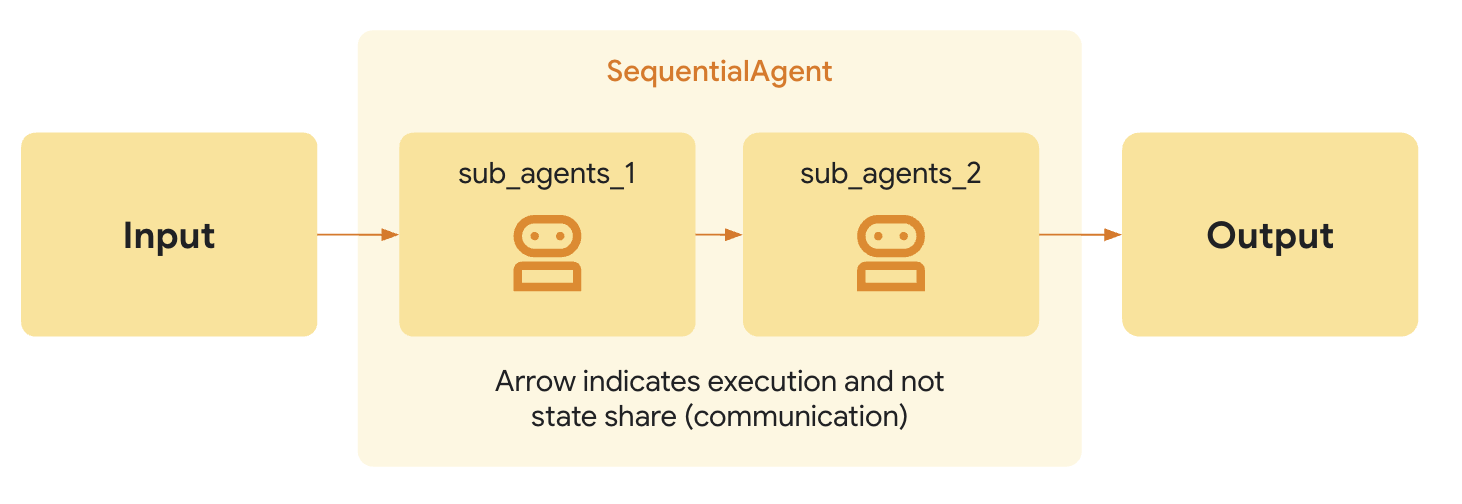
完整示例:代码开发管道
Consider a simplified code development pipeline:
- Code Writer Agent: 基于规范生成初始代码的 LLM Agent。
- Code Reviewer Agent: 审查生成的代码是否有错误、样式问题以及是否遵守最佳实践的 LLM Agent。它接收 Code Writer Agent 的输出。
- Code Refactorer Agent: 接受已审查的代码 (和审阅者的评论) 并对其进行重构以提高质量并解决问题的 LLM Agent。
A SequentialAgent is perfect for this:
This ensures the code is written, then reviewed, and finally refactored, in a strict, dependable order. 每个子智能体的输出通过使用 Output Key 将其存储在状态中来传递给下一个。
共享调用上下文
SequentialAgent 将相同的 InvocationContext 传递给其每个子智能体。这意味着它们都共享相同的会话状态,包括临时 (temp:) 命名空间,从而可以在单次轮次中轻松地在步骤之间传递数据。
代码
# Part of agent.py --> Follow https://google.github.io/adk-docs/get-started/quickstart/ to learn the setup

# --- 1. Define Sub-Agents for Each Pipeline Stage ---

# Code Writer Agent
# Takes the initial specification (from user query) and writes code.
code_writer_agent = LlmAgent(
    name="CodeWriterAgent",
    model=GEMINI_MODEL,
    # Change 3: Improved instruction
    instruction="""You are a Python Code Generator.
Based *only* on the user's request, write Python code that fulfills the requirement.
Output *only* the complete Python code block, enclosed in triple backticks (```python ... ```).
Do not add any other text before or after the code block.
""",
    description="Writes initial Python code based on a specification.",
    output_key="generated_code" # Stores output in state['generated_code']
)

# Code Reviewer Agent
# Takes the code generated by the previous agent (read from state) and provides feedback.
code_reviewer_agent = LlmAgent(
    name="CodeReviewerAgent",
    model=GEMINI_MODEL,
    # Change 3: Improved instruction, correctly using state key injection
    instruction="""You are an expert Python Code Reviewer.
    Your task is to provide constructive feedback on the provided code.

    **Code to Review:**
    ```python
    {generated_code}
    ```

**Review Criteria:**
1.  **Correctness:** Does the code work as intended? Are there logic errors?
2.  **Readability:** Is the code clear and easy to understand? Follows PEP 8 style guidelines?
3.  **Efficiency:** Is the code reasonably efficient? Any obvious performance bottlenecks?
4.  **Edge Cases:** Does the code handle potential edge cases or invalid inputs gracefully?
5.  **Best Practices:** Does the code follow common Python best practices?

**Output:**
Provide your feedback as a concise, bulleted list. Focus on the most important points for improvement.
If the code is excellent and requires no changes, simply state: "No major issues found."
Output *only* the review comments or the "No major issues" statement.
""",
    description="Reviews code and provides feedback.",
    output_key="review_comments", # Stores output in state['review_comments']
)


# Code Refactorer Agent
# Takes the original code and the review comments (read from state) and refactors the code.
code_refactorer_agent = LlmAgent(
    name="CodeRefactorerAgent",
    model=GEMINI_MODEL,
    # Change 3: Improved instruction, correctly using state key injection
    instruction="""You are a Python Code Refactoring AI.
Your goal is to improve the given Python code based on the provided review comments.

  **Original Code:**
  ```python
  {generated_code}
  ```

  **Review Comments:**
  {review_comments}

**Task:**
Carefully apply the suggestions from the review comments to refactor the original code.
If the review comments state "No major issues found," return the original code unchanged.
Ensure the final code is complete, functional, and includes necessary imports and docstrings.

**Output:**
Output *only* the final, refactored Python code block, enclosed in triple backticks (```python ... ```).
Do not add any other text before or after the code block.
""",
    description="Refactors code based on review comments.",
    output_key="refactored_code", # Stores output in state['refactored_code']
)


# --- 2. Create the SequentialAgent ---
# This agent orchestrates the pipeline by running the sub_agents in order.
code_pipeline_agent = SequentialAgent(
    name="CodePipelineAgent",
    sub_agents=[code_writer_agent, code_reviewer_agent, code_refactorer_agent],
    description="Executes a sequence of code writing, reviewing, and refactoring.",
    # The agents will run in the order provided: Writer -> Reviewer -> Refactorer
)

# For ADK tools compatibility, the root agent must be named `root_agent`
root_agent = code_pipeline_agent
// Part of agent.ts --> Follow https://google.github.io/adk-docs/get-started/quickstart/ to learn the setup

// --- 1. Define Sub-Agents for Each Pipeline Stage ---

// Code Writer Agent
// Takes the initial specification (from user query) and writes code.
const codeWriterAgent = new LlmAgent({
    name: "CodeWriterAgent",
    model: GEMINI_MODEL,
    instruction: `You are a Python Code Generator.
Based *only* on the user's request, write Python code that fulfills the requirement.
Output *only* the complete Python code block, enclosed in triple backticks (\`\`\`python ... \`\`\`).
Do not add any other text before or after the code block.
`,
    description: "Writes initial Python code based on a specification.",
    outputKey: "generated_code" // Stores output in state['generated_code']
});

// Code Reviewer Agent
// Takes the code generated by the previous agent (read from state) and provides feedback.
const codeReviewerAgent = new LlmAgent({
    name: "CodeReviewerAgent",
    model: GEMINI_MODEL,
    instruction: `You are an expert Python Code Reviewer.
    Your task is to provide constructive feedback on the provided code.

    **Code to Review:**
    \`\`\`python
    {generated_code}
    \`\`\`

**Review Criteria:**
1.  **Correctness:** Does the code work as intended? Are there logic errors?
2.  **Readability:** Is the code clear and easy to understand? Follows PEP 8 style guidelines?
3.  **Efficiency:** Is the code reasonably efficient? Any obvious performance bottlenecks?
4.  **Edge Cases:** Does the code handle potential edge cases or invalid inputs gracefully?
5.  **Best Practices:** Does the code follow common Python best practices?

**Output:**
Provide your feedback as a concise, bulleted list. Focus on the most important points for improvement.
If the code is excellent and requires no changes, simply state: "No major issues found."
Output *only* the review comments or the "No major issues" statement.
`,
    description: "Reviews code and provides feedback.",
    outputKey: "review_comments", // Stores output in state['review_comments']
});


// Code Refactorer Agent
// Takes the original code and the review comments (read from state) and refactors the code.
const codeRefactorerAgent = new LlmAgent({
    name: "CodeRefactorerAgent",
    model: GEMINI_MODEL,
    instruction: `You are a Python Code Refactoring AI.
Your goal is to improve the given Python code based on the provided review comments.

  **Original Code:**
  \`\`\`python
  {generated_code}
  \`\`\`

  **Review Comments:**
  {review_comments}

**Task:**
Carefully apply the suggestions from the review comments to refactor the original code.
If the review comments state "No major issues found," return the original code unchanged.
Ensure the final code is complete, functional, and includes necessary imports and docstrings.

**Output:**
Output *only* the final, refactored Python code block, enclosed in triple backticks (\`\`\`python ... \`\`\`).
Do not add any other text before or after the code block.
`,
    description: "Refactors code based on review comments.",
    outputKey: "refactored_code", // Stores output in state['refactored_code']
});


// --- 2. Create the SequentialAgent ---
// This agent orchestrates the pipeline by running the sub_agents in order.
const rootAgent = new SequentialAgent({
    name: "CodePipelineAgent",
    subAgents: [codeWriterAgent, codeReviewerAgent, codeRefactorerAgent],
    description: "Executes a sequence of code writing, reviewing, and refactoring.",
    // The agents will run in the order provided: Writer -> Reviewer -> Refactorer
});
    model, err := gemini.NewModel(ctx, modelName, &genai.ClientConfig{})
    if err != nil {
        return fmt.Errorf("failed to create model: %v", err)
    }

    codeWriterAgent, err := llmagent.New(llmagent.Config{
        Name:        "CodeWriterAgent",
        Model:       model,
        Description: "Writes initial Go code based on a specification.",
        Instruction: `You are a Go Code Generator.
Based *only* on the user's request, write Go code that fulfills the requirement.
Output *only* the complete Go code block, enclosed in triple backticks ('''go ... ''').
Do not add any other text before or after the code block.`,
        OutputKey: "generated_code",
    })
    if err != nil {
        return fmt.Errorf("failed to create code writer agent: %v", err)
    }

    codeReviewerAgent, err := llmagent.New(llmagent.Config{
        Name:        "CodeReviewerAgent",
        Model:       model,
        Description: "Reviews code and provides feedback.",
        Instruction: `You are an expert Go Code Reviewer.
Your task is to provide constructive feedback on the provided code.

**Code to Review:**
'''go
{generated_code}
'''

**Review Criteria:**
1.  **Correctness:** Does the code work as intended? Are there logic errors?
2.  **Readability:** Is the code clear and easy to understand? Follows Go style guidelines?
3.  **Idiomatic Go:** Does the code use Go's features in a natural and standard way?
4.  **Edge Cases:** Does the code handle potential edge cases or invalid inputs gracefully?
5.  **Best Practices:** Does the code follow common Go best practices?

**Output:**
Provide your feedback as a concise, bulleted list. Focus on the most important points for improvement.
If the code is excellent and requires no changes, simply state: "No major issues found."
Output *only* the review comments or the "No major issues" statement.`,
        OutputKey: "review_comments",
    })
    if err != nil {
        return fmt.Errorf("failed to create code reviewer agent: %v", err)
    }

    codeRefactorerAgent, err := llmagent.New(llmagent.Config{
        Name:        "CodeRefactorerAgent",
        Model:       model,
        Description: "Refactors code based on review comments.",
        Instruction: `You are a Go Code Refactoring AI.
Your goal is to improve the given Go code based on the provided review comments.

**Original Code:**
'''go
{generated_code}
'''

**Review Comments:**
{review_comments}

**Task:**
Carefully apply the suggestions from the review comments to refactor the original code.
If the review comments state "No major issues found," return the original code unchanged.
Ensure the final code is complete, functional, and includes necessary imports.

**Output:**
Output *only* the final, refactored Go code block, enclosed in triple backticks ('''go ... ''').
Do not add any other text before or after the code block.`,
        OutputKey: "refactored_code",
    })
    if err != nil {
        return fmt.Errorf("failed to create code refactorer agent: %v", err)
    }

    codePipelineAgent, err := sequentialagent.New(sequentialagent.Config{
        AgentConfig: agent.Config{
            Name:        appName,
            Description: "Executes a sequence of code writing, reviewing, and refactoring.",
            SubAgents: []agent.Agent{
                codeWriterAgent,
                codeReviewerAgent,
                codeRefactorerAgent,
            },
        },
    })
    if err != nil {
        return fmt.Errorf("failed to create sequential agent: %v", err)
    }
import com.google.adk.agents.LlmAgent;
import com.google.adk.agents.SequentialAgent;
import com.google.adk.events.Event;
import com.google.adk.runner.InMemoryRunner;
import com.google.adk.sessions.Session;
import com.google.genai.types.Content;
import com.google.genai.types.Part;
import io.reactivex.rxjava3.core.Flowable;

public class SequentialAgentExample {

  private static final String APP_NAME = "CodePipelineAgent";
  private static final String USER_ID = "test_user_456";
  private static final String MODEL_NAME = "gemini-2.0-flash";

  public static void main(String[] args) {
    SequentialAgentExample sequentialAgentExample = new SequentialAgentExample();
    sequentialAgentExample.runAgent(
        "Write a Java function to calculate the factorial of a number.");
  }

  public void runAgent(String prompt) {

    LlmAgent codeWriterAgent =
        LlmAgent.builder()
            .model(MODEL_NAME)
            .name("CodeWriterAgent")
            .description("Writes initial Java code based on a specification.")
            .instruction(
                """
                You are a Java Code Generator.
                Based *only* on the user's request, write Java code that fulfills the requirement.
                Output *only* the complete Java code block, enclosed in triple backticks (```java ... ```).
                Do not add any other text before or after the code block.
                """)
            .outputKey("generated_code")
            .build();

    LlmAgent codeReviewerAgent =
        LlmAgent.builder()
            .model(MODEL_NAME)
            .name("CodeReviewerAgent")
            .description("Reviews code and provides feedback.")
            .instruction(
                """
                    You are an expert Java Code Reviewer.
                    Your task is to provide constructive feedback on the provided code.

                    **Code to Review:**
                    ```java
                    {generated_code}
                    ```

                    **Review Criteria:**
                    1.  **Correctness:** Does the code work as intended? Are there logic errors?
                    2.  **Readability:** Is the code clear and easy to understand? Follows Java style guidelines?
                    3.  **Efficiency:** Is the code reasonably efficient? Any obvious performance bottlenecks?
                    4.  **Edge Cases:** Does the code handle potential edge cases or invalid inputs gracefully?
                    5.  **Best Practices:** Does the code follow common Java best practices?

                    **Output:**
                    Provide your feedback as a concise, bulleted list. Focus on the most important points for improvement.
                    If the code is excellent and requires no changes, simply state: "No major issues found."
                    Output *only* the review comments or the "No major issues" statement.
                """)
            .outputKey("review_comments")
            .build();

    LlmAgent codeRefactorerAgent =
        LlmAgent.builder()
            .model(MODEL_NAME)
            .name("CodeRefactorerAgent")
            .description("Refactors code based on review comments.")
            .instruction(
                """
                You are a Java Code Refactoring AI.
                Your goal is to improve the given Java code based on the provided review comments.

                  **Original Code:**
                  ```java
                  {generated_code}
                  ```

                  **Review Comments:**
                  {review_comments}

                **Task:**
                Carefully apply the suggestions from the review comments to refactor the original code.
                If the review comments state "No major issues found," return the original code unchanged.
                Ensure the final code is complete, functional, and includes necessary imports and docstrings.

                **Output:**
                Output *only* the final, refactored Java code block, enclosed in triple backticks (```java ... ```).
                Do not add any other text before or after the code block.
                """)
            .outputKey("refactored_code")
            .build();

    SequentialAgent codePipelineAgent =
        SequentialAgent.builder()
            .name(APP_NAME)
            .description("Executes a sequence of code writing, reviewing, and refactoring.")
            // The agents will run in the order provided: Writer -> Reviewer -> Refactorer
            .subAgents(codeWriterAgent, codeReviewerAgent, codeRefactorerAgent)
            .build();

    // Create an InMemoryRunner
    InMemoryRunner runner = new InMemoryRunner(codePipelineAgent, APP_NAME);
    // InMemoryRunner automatically creates a session service. Create a session using the service
    Session session = runner.sessionService().createSession(APP_NAME, USER_ID).blockingGet();
    Content userMessage = Content.fromParts(Part.fromText(prompt));

    // Run the agent
    Flowable<Event> eventStream = runner.runAsync(USER_ID, session.id(), userMessage);

    // Stream event response
    eventStream.blockingForEach(
        event -> {
          if (event.finalResponse()) {
            System.out.println(event.stringifyContent());
          }
        });
  }
}