第8章
技能剖析——结构与设计模式
8.1 从临时提示到可重复的工作流
这个季度你已经综合了五次客户反馈。每次都是打开Claude Code,输入同一提示的变体,等待结果,意识到忘了指定输出格式,迭代调整,得到能用的东西,然后继续。下个月,你又会再来一次。你不会记得具体什么好用,会花20分钟重新摸索出正确的提示结构。输出结果会和上次略有不同,使得跨季度的比较更加困难。
这就是提示跑步机。你不断重复做同样的工作,却没有从重复中获得复利价值。技能解决了这个问题。
技能是一个文档化的工作流,Claude Code按需执行。你一次性地定义流程:需要什么输入,遵循什么步骤,产生什么输出,什么样算质量合格。然后你按名称调用它。Claude Code按照你文档化的流程执行,产生一致的结果,无论距离你创建它过去了多长时间。
复利价值是显著的。第一次季度反馈综合需要45分钟,包括提示迭代。有了技能,第二次只需10分钟。第三次也是10分钟。到第四个季度,你节省了两小时的工作时间,并且获得了跨时间段的一致性,使趋势分析成为可能。
本章涵盖技能结构和设计模式。第9章提供完整的示例,并手把手带你构建你的第一个技能。掌握这两章,你就能将重复的PM任务从认知负担转化为可靠的流程。
8.2 什么是技能?
技能是一个告诉Claude Code如何执行特定工作流的markdown文件。它存放在项目的.claude/skills/目录(通过git与团队共享)或~/.claude/skills/(个人的,跨所有项目可用)中。当你调用一个技能,或者当Claude Code识别到你的请求与某个技能的描述匹配时,它会遵循文档化的指令,而非即兴发挥。
技能与提示:区分很重要。提示是一次性的指令。你输入它,Claude Code响应,然后提示就消失在会话历史中了。如果你想下周做同样的事,你需要重新写提示(或者翻找历史记录,希望记得你是什么时候运行的)。
技能是持久化的指令集。它以文件形式存在,像其他项目产物一样进行版本控制。当你下周运行该技能时,它执行的是相同的文档化流程。当团队成员运行时,他们获得一致的行为。当你更新技能时,每个人都从改进中受益。
区别在于持久性和可重复性:
| 方面 | 提示 | 技能 |
|---|---|---|
| 持久性 | 仅限当前会话 | 仓库中的文件 |
| 可重复性 | 需要回忆 | 按名称调用 |
| 一致性 | 每次不同 | 文档化的流程 |
| 可共享性 | 复制粘贴 | Git提交 |
| 演进 | 丢失于历史中 | 版本控制 |
技能存放位置。Claude Code在两个位置查找技能:
- 项目级别:当前目录中的
.claude/skills/。这些技能是项目特定的,与克隆仓库的团队成员共享。用于与产品绑定的技能:针对你特定数据格式的反馈综合、针对你仓库规范的发布说明、针对你团队检查清单的PRD审计。
- 个人级别:主目录中的
~/.claude/skills/。这些技能跟随你跨所有项目。用于通用的PM工作流:竞品分析模板、用户故事展开模式、会议笔记综合。
每个技能是一个子目录,至少包含一个文件:SKILL.md。目录名成为技能的标识符。复杂的技能可以包含额外的文件:辅助脚本、参考文档、输出模板。
.claude/skills/├── feedback-synthesis/│ └── SKILL.md├── release-notes/│ ├── SKILL.md│ └── resources/│ └── customer-voice-guide.md└── prd-audit/ ├── SKILL.md └── resources/ └── prd-checklist.md
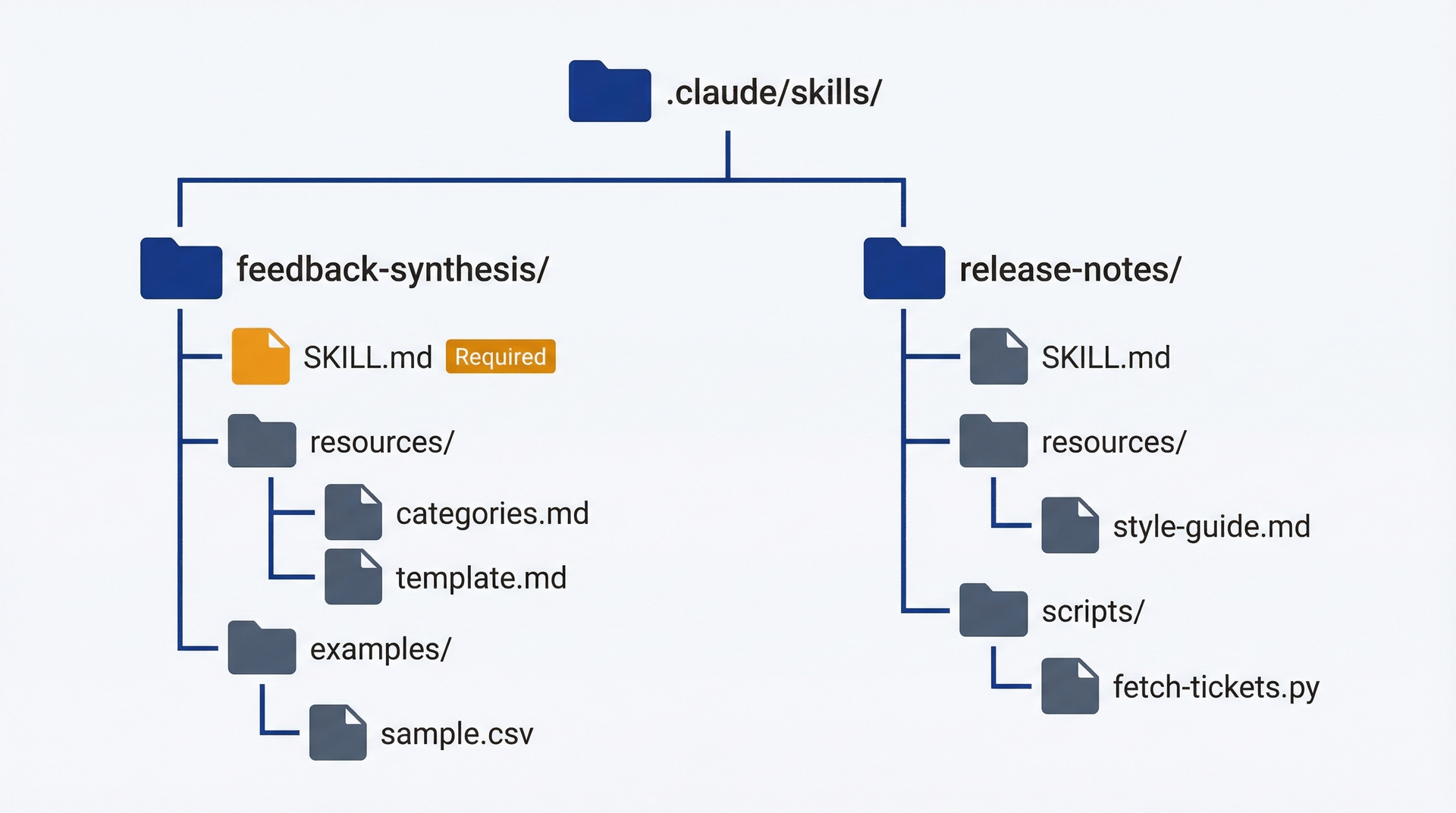
图8.1:技能目录结构——使用此图来组织你的技能,包含必需的SKILL.md文件和可选的辅助资源、脚本及示例文件夹。
技能如何被发现和调用。Claude Code使用技能描述来判断相关性。当你发出请求时,Claude会读取每个技能YAML前置信息中的description字段,并判断是否有任何技能适用。如果你提供反馈CSV并要求"将其综合为主题",Claude Code会匹配一个描述中提到"反馈综合"的技能并自动激活它。
你也可以将技能作为斜杠命令显式调用。名为feedback-synthesis的技能变为/feedback-synthesis。这种显式调用保证技能会运行,无论你如何措辞你的请求。
自动发现行为很有用,但并非魔法。如果你的技能描述不包含用户实际会说的话,Claude Code就不会匹配。"分析客户情感数据"不会在你输入"总结这份反馈"时触发。包含与自然请求匹配的触发词:"综合客户反馈、NPS回复、支持工单主题"。
技能的复利价值。第一次构建一个技能需要30-60分钟。使用一个技能需要5-10分钟。算账很简单:
- 使用2次:构建60分钟 + 使用20分钟 = 总共80分钟,对比临时方式的90分钟
- 使用5次:60 + 50 = 110分钟,对比临时方式的225分钟
- 使用10次:60 + 100 = 160分钟,对比临时方式的450分钟
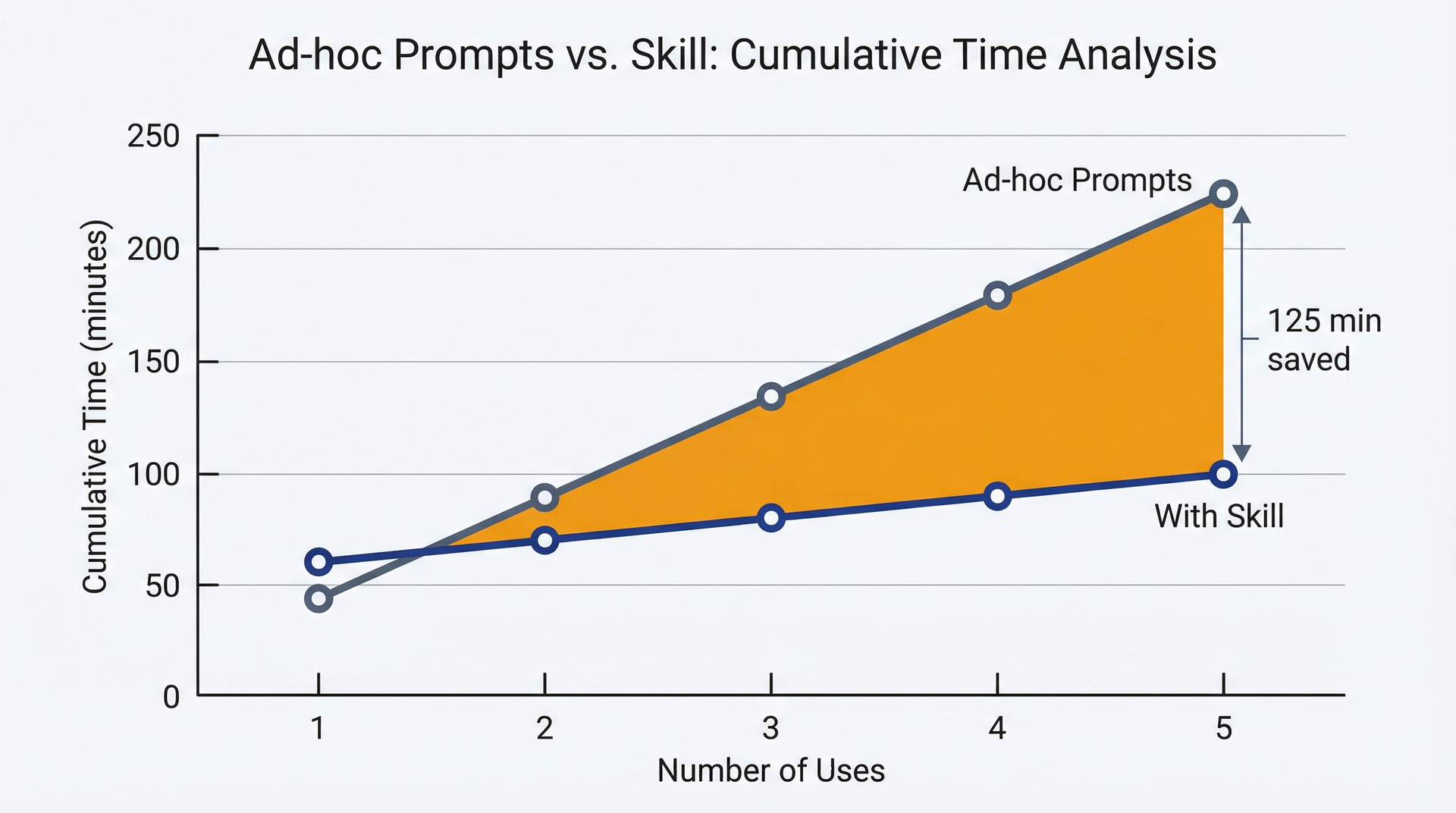
图8.2:技能复利价值——使用此图为构建技能的初始投资提供理由。临时提示呈线性增长(每次使用45分钟),而技能有更高的初始投入(构建60分钟),但平摊到每次使用仅10分钟。到第五次使用时,技能相比临时方式节省125分钟。
除了时间节省,技能还提供一致性。季度报告遵循相同的结构。反馈主题使用相同的分类标准。PRD审计检查相同的项目。这种一致性使得跨时间段的比较成为可能,并降低了输出成果消费者的认知负担。
8.3 技能组件
一个技能目录包含若干类型的文件。只有SKILL.md是必需的;其他文件为复杂工作流扩展能力。
SKILL.md:指令文件。这是每个技能的核心。它包含用于发现的YAML前置信息和用于执行的markdown指令。Claude Code在技能激活时读取此文件,并遵循文档化的流程。
最小可行SKILL.md:
---name: standup-notesdescription: Generate standup notes from yesterday's git commits. Use when user mentions standup, daily update, or what I did yesterday.---# Standup Notes## PurposeCreate formatted standup notes from recent commits.## Inputs- Git repository with commit history## Process1. Read commits from the past 24 hours2. Group by type (feature, fix, refactor)3. Write in first person, past tense## OutputPrint standup notes to terminal. Do not create a file.
这个最小结构适用于简单的工作流。更复杂的技能需要第8.3节中涵盖的额外部分。
参考文件:数据、评分标准、模板。技能可以包含Claude Code在执行过程中查阅的辅助文件。这些文件存放在resources/子目录中:
feedback-synthesis/├── SKILL.md└── resources/ ├── category-definitions.md ├── output-template.md └── quality-rubric.md
参考文件服务于多种目的:
- 分类定义:当综合反馈时,Claude Code应该使用什么分类?一次性在
category-definitions.md中定义它们,而不是嵌入到SKILL.md指令中。
- 输出模板:生成产物的精确结构。"遵循
resources/output-template.md中的模板"比将模板嵌入到指令中更清晰。
- 质量标准:评估输出的详细标准。使SKILL.md聚焦于流程,而将评估标准委托给一个参考文件。
- 风格指南:语气、语调和格式偏好。对生成面向客户内容的技能很有用。
在你的SKILL.md中,显式引用这些文件:"使用resources/category-definitions.md中的定义对反馈进行分类。"Claude Code会在到达该指令时读取被引用的文件。
输出模板:一致的格式。如果你的技能产生文档,定义预期结构:
Output FormatGenerate file: reports/feedback-synthesis-[date].mdFollow this structure:# Feedback Synthesis: [Date Range]## Executive Summary[3-5 bullet points of key findings]## Theme Analysis### Theme 1: [Name]- Frequency: [count] mentions ([percentage]%)- Sentiment: [positive/negative/mixed]- Representative quotes: - "[Quote 1]" - "[Quote 2]"- Implications: [What this means for the product][Repeat for each theme]## Recommendations[Prioritized list of suggested actions]## Methodology[Brief description of data sources and analysis approach]
这个模板确保每个反馈综合报告都具有相同的结构,使得跨时间段比较更加容易,也更容易向预期有固定格式的利益相关者展示。
可选脚本:预处理/后处理。复杂的技能可以包含辅助脚本,用于处理纯对话无法高效完成的任务:
release-notes/├── SKILL.md└── scripts/ └── fetch-jira-tickets.py
SKILL.md引用该脚本:"在生成说明之前,运行scripts/fetch-jira-tickets.py --sprint [sprint-name]收集工单数据。"
对于PM技能,脚本很少是必需的。大多数PM工作流涉及文本分析和文档生成,Claude Code可以通过对话方式处理。脚本在以下场景中变得有用:
- 需要特定认证来调用外部API
- 处理直接读取会消耗过多token的大数据集
- 在分析之前转换数据格式
如果你发现需要脚本,考虑MCP集成(第10章)是否更简洁。
目录结构约定。一致地组织技能目录:
skill-name/├── SKILL.md # 必需:核心指令├── resources/ # 可选:参考文档│ ├── template.md│ └── rubric.md├── scripts/ # 可选:辅助脚本│ └── helper.py└── examples/ # 可选:示例输入/输出 ├── sample-input.csv └── expected-output.md
examples/目录对测试和文档说明很有用。包含示例输入及其应产生的输出。这有助于团队成员理解技能的功能,也有助于你在修改后验证技能是否仍然正常工作。
8.4 SKILL.md文件详解
SKILL.md结合了发现元数据和执行指令。理解这两部分有助于你编写在适当时刻激活并可靠执行的技能。
必需:YAML前置信息。每个SKILL.md以---分隔的前置信息开始:
---name: feedback-synthesisdescription: Synthesizes customer feedback into themed reports. Auto-invoke when user mentions feedback analysis, NPS synthesis, support ticket themes, or customer sentiment.---
两个字段是必需的:
- name:唯一标识符,小写加连字符。它成为斜杠命令(
/feedback-synthesis)和技能的显示名称。保持简洁且具描述性。
- description:Claude Code用来决定何时激活技能的发现文本。包含与用户自然措辞请求方式匹配的触发词。要具体:"综合客户反馈"比"帮助数据分析"匹配得更可靠。
描述服务于两个目的:帮助Claude Code自动发现技能何时适用,以及帮助人类读者理解技能的功能。为这两类受众编写。
Markdown正文中的必需部分。在前置信息之后,用以下各部分结构化你的SKILL.md:
目的声明。用一两句话解释技能完成什么以及为什么有价值。以用户收益开头,而非流程:
PurposeTransform raw customer feedback into actionable insight reports that product teams can use for prioritization decisions.
这告诉读者他们能得到什么,而不是技能内部如何运作。
输入要求。指定用户必须提供什么:
Expected Inputs- Required: CSV or text file containing customer feedback (one piece of feedback per row)- Optional: Date range for filtering (defaults to last 30 days)- Supports: CSV, JSON, plain text files- Minimum: 10 feedback entries for meaningful analysis
在格式方面要具体。"CSV文件"是模糊的;"反馈文本在名为'feedback'或'comment'列中的CSV文件"告诉Claude Code要寻找什么。
执行步骤。Claude Code遵循的编号步骤:
Process1. Read and validate input file - Confirm file exists and has expected format - Identify the feedback column - Report record count2. Identify themes - Read through all feedback entries - Group by common topics or concerns - Use category definitions from resources/categories.md if strict categorization is needed3. Analyze each theme - Count frequency - Assess sentiment (positive, negative, mixed) - Extract representative quotes (verbatim, not paraphrased)4. Generate report - Follow template in resources/output-template.md - Include executive summary, theme analysis, and recommendations - Save to reports/feedback-synthesis-[date].md5. Quality check - Verify all themes have supporting quotes - Confirm percentages sum to approximately 100% - Check that recommendations are actionable
使用祈使语气("读取文件"而非"文件应被读取")。包含决策点("如果少于10条记录,警告并附上保留声明继续")。适当时引用外部文件。
输出格式规范。精确定义生成什么:
Output FormatGenerate file: reports/feedback-synthesis-YYYY-MM-DD.mdStructure:- Executive summary (3-5 bullets)- Theme analysis (one section per theme with frequency, sentiment, quotes, implications)- Recommendations (prioritized list)- Methodology (brief description)See resources/output-template.md for detailed structure.
指定文件路径模式可确保一致的输出位置。团队知道在哪里找到反馈报告而不需要询问。
质量标准。成功执行的可测试标准:
Quality Criteria- Every theme has at least 2 supporting quotes- Quotes are verbatim from source data, not paraphrased- Sentiment assessment explains the reasoning- Recommendations tie back to specific themes- File saves successfully to specified path
这些标准让Claude Code在完成前进行自我检查。它们也帮助你评估技能执行是否成功。
可选部分。当能提高清晰度或可靠性时添加这些:
调用示例。展示如何使用该技能:
Usage Examples- Standard: "Run feedback-synthesis on data/customer-feedback-q4.csv"- With date range: "Run feedback-synthesis on feedback.csv for November only"- Quick version: "Run feedback-synthesis, just give me the top 3 themes"
常见失败模式。记录什么会出错以及如何处理:
Edge Cases- Sparse data (<10 entries): Generate report with caveat about limited sample size- Mixed formats: If feedback column isn't obvious, ask user to specify- Very long feedback entries: Summarize individual entries exceeding 500 words- Non-English content: Note language and proceed; don't attempt translation
相关技能。指出与该技能互补的其他技能:
Related Skills- prd-audit: Use insights from feedback synthesis to audit PRD completeness- user-story-expander: Turn feedback themes into user stories
完整注释示例。以下是反馈综合的完整SKILL.md:
---name: feedback-synthesisdescription: Synthesizes customer feedback into themed reports with actionable insights. Auto-invoke when user mentions feedback analysis, NPS synthesis, support ticket themes, customer sentiment, or voice of customer.---# Feedback Synthesis## PurposeTransform raw customer feedback into actionable insight reports that product teams can use for prioritization decisions.## Expected Inputs- Required: File containing customer feedback (CSV, JSON, or plain text)- Optional: Date range, specific focus areas- Minimum 10 feedback entries for meaningful analysis- Supports feedback from: support tickets, NPS surveys, user interviews, app store reviews## Process1. Read and validate input - Confirm file exists and is readable - Identify feedback content (look for columns: feedback, comment, response, review) - Report total entry count2. Identify themes - Group feedback by common topics - Aim for 4-8 themes (merge if too granular, split if too broad) - Name themes descriptively: "Onboarding Confusion" not "Theme 1"3. Analyze each theme - Count frequency (entries mentioning this theme) - Calculate percentage of total feedback - Assess sentiment: positive, negative, or mixed - Extract 2-3 representative quotes (verbatim) - Identify implications for product decisions4. Synthesize findings - Write executive summary (top 3-5 findings) - Prioritize themes by frequency and business impact - Generate actionable recommendations5. Generate report - Save to reports/feedback-synthesis-YYYY-MM-DD.md - Follow structure in Output Format section6. Quality check - Verify all themes have supporting quotes - Confirm recommendations are specific and actionable - Check that executive summary captures key points## Output FormatGenerate file: reports/feedback-synthesis-YYYY-MM-DD.md# Feedback Synthesis: [Date Range]## Executive Summary- [Key finding 1]- [Key finding 2]- [Key finding 3]## Theme Analysis### [Theme Name]- Frequency: [X] mentions ([Y]% of feedback)- Sentiment: [Positive/Negative/Mixed]- Representative Quotes: - "[Quote 1]" - "[Quote 2]"- Product Implications: [What this means for roadmap/priorities][Repeat for each theme]## Recommendations1. [Specific action tied to theme]2. [Specific action tied to theme]3. [Specific action tied to theme]## Methodology- Source: [File name]- Period: [Date range]- Sample size: [X] feedback entries- Analysis date: [Today's date]## Quality Criteria- Every theme supported by at least 2 verbatim quotes- Quotes are exact text from source, not paraphrased- Percentages sum to approximately 100% (themes can overlap)- Recommendations are specific enough to be actionable- Executive summary is readable in under 30 seconds## Edge Cases- Sparse data (<10 entries): Proceed with caveat about limited sample- Ambiguous feedback column: Ask user to specify which column contains feedback- Multi-language content: Note language distribution; analyze separately if significant- Very long entries (>500 words): Summarize before categorizing## Usage Examples- "Run feedback-synthesis on data/q4-feedback.csv"- "Synthesize the NPS responses in surveys/november.json"- "Analyze customer feedback from support-tickets.txt, focus on billing issues"
这个技能大约600个单词——内容充实但不超过SKILL.md文件的5,000单词限制。对于需要更多细节的技能,将参考材料移到单独的文件中。
8.5 PM技能的设计模式
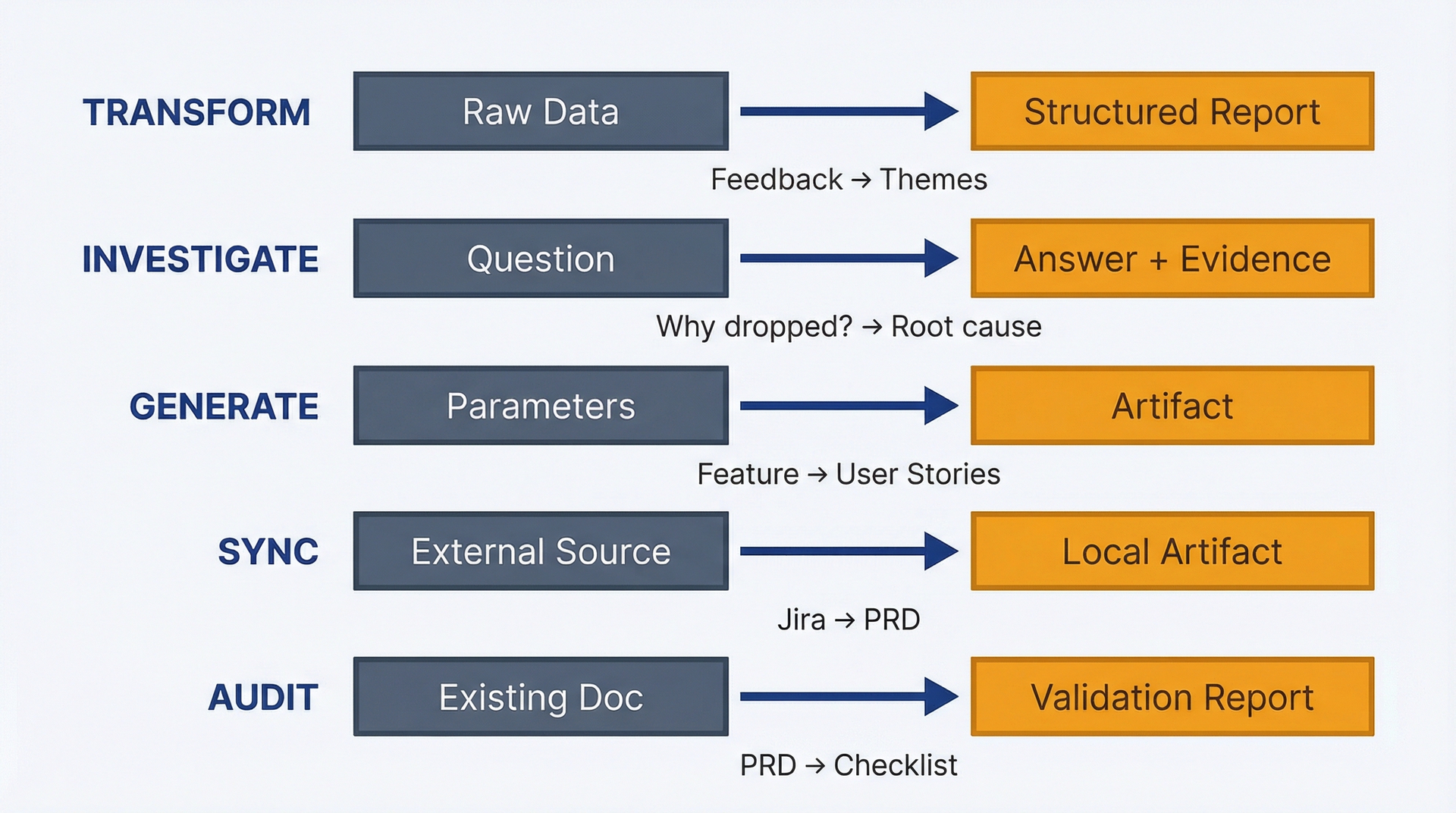
图8.3:五种PM技能模式——使用此图为你的工作流选择合适的结构。Transform(原始数据→结构化报告)、Investigate(问题→带证据的答案)、Generate(参数→产物)、Sync(外部来源→本地产物)、Audit(现有文档→验证报告)。将你的任务与模式匹配以实现更快的技能开发。
五种模式涵盖大多数PM技能需求。识别你的工作流适合哪种模式,并相应地构建你的技能。
Transform模式:输入→结构化输出。你有非结构化或半结构化的数据。你需要结构化的分析或文档。
示例:- 原始反馈→主题报告 - 访谈记录→洞察摘要 - Git提交→发布说明 - 会议笔记→行动项
结构:
Process1. Read and validate input data2. Apply transformation logic (categorize, summarize, restructure)3. Generate structured output4. Quality check against criteria
Transform技能具有明确的输入和输出。它们是最常见的PM技能模式。
Investigate模式:问题→带证据的答案。你需要通过检查数据或代码库来回答问题,并附上支持证据。
示例:- "为什么转化率下降了?"→带数据引用的根本原因分析 - "功能X是如何工作的?"→带文件引用的解释 - "客户对定价有什么看法?"→带支持引用的总结
结构:
Process1. Understand the question2. Identify relevant data sources3. Analyze sources for answer4. Compile evidence (quotes, references, data points)5. Synthesize answer with supporting evidence
Investigate技能与Transform技能的区别在于输出结构取决于发现了什么,而不是预定的模板。
Generate模式:参数→产物。你提供规格;技能生成与之匹配的文档或产物。
示例:- 功能描述→带验收标准的用户故事 - Sprint目标→状态报告 - 产品领域→竞品分析
结构:
Process1. Accept parameters (feature name, date range, focus area)2. Gather context (from codebase, templates, reference docs)3. Generate artifact following template4. Validate against quality criteria
Generate技能是模板驱动的。输出结构是固定的;内容根据参数而变化。
Sync模式:外部来源→本地产物。你从外部系统拉取数据,并创建或更新本地文档。
示例:- Jira epic→仓库中的PRD部分 - 分析仪表盘→每周指标摘要 - 竞品网站→更新后的竞品档案
结构:
Process1. Connect to external source (via MCP or export)2. Extract relevant data3. Transform to local format4. Create or update local artifact5. Note sync timestamp
Sync技能通常需要MCP连接(第10章)或手动数据导出作为输入。
Audit模式:产物→验证报告。你有一个现存产物。你需要根据标准评估它并报告发现。
示例:- PRD→完整性检查清单 - 用户故事→质量评估 - 文档→针对代码的准确性验证
结构:
Process1. Read artifact to audit2. Load evaluation criteria (from reference file)3. Evaluate artifact against each criterion4. Compile findings (what passes, what fails, what's missing)5. Generate recommendations for improvement
Audit技能对质量门槛很有价值:在工程交接前运行PRD审计,尽早发现差距。
选择合适的模式。问自己:
- 我是否有需要结构化的数据?→ Transform
- 我是否在回答一个问题?→ Investigate
- 我是否在根据规格创建东西?→ Generate
- 我是否在将外部数据拉入我的仓库?→ Sync
- 我是否在评估现有工作?→ Audit
有些工作流组合多种模式。季度评审可能先Sync分析数据,再Transform为报告,再Audit报告对比上季度目标。从主要模式开始,然后再扩展。
8.6 确定性与可重复性
给定相似的输入,技能应该产生相似的输出。完全的确定性是不可能的(语言模型具有固有的变异性),但你可以通过技能设计来提高一致性。
为什么一致性对PM工作流很重要。不一致的输出削弱了技能的价值主张:
- 季度反馈报告应跨季度可比
- PRD审计每次应检查相同的标准
- 发布说明无论何时生成都应遵循相同的格式
如果每次技能执行都产生不同的结构或使用不同的标准,你只是回到了临时提示迭代的老路,只是多了几个步骤。
提高输出可预测性的技巧。
显式模式。不要说"生成一份报告",而要说"生成一份包含以下确切各部分、按此顺序排列的报告"。你的输出格式越具体,结果就越一致。
Output FormatGenerate with exactly these sections, in this order:1. Executive Summary (3-5 bullets)2. Theme Analysis (one subsection per theme)3. Recommendations (numbered list, max 5 items)4. Methodology (one paragraph)
参考文件锚定。将可变内容移到参考文件中:
ProcessCategorize feedback using exactly the categories defined inresources/category-definitions.md. Do not create new categories.
这将技能锚定到固定的标准上。更新参考文件来改变行为;SKILL.md指令保持稳定。
显式质量标准。可测试的标准减少变异性:
Quality Criteria- Executive summary contains exactly 3-5 bullet points- Each theme section includes frequency count and percentage- All quotes are verbatim from source data- Recommendations reference specific themes by name
Claude Code使用这些标准进行自我检查,在输出前捕捉偏差。
约束化解读。限制Claude Code如何处理模糊情况:
Edge Cases- If a feedback entry could fit multiple themes, assign to the most specific theme- If sentiment is unclear, mark as "mixed" rather than guessing- If entry is too short to categorize (<10 words), count it but don't quote it
这些约束减少了Claude Code在边界情况下每次可能做出不同选择的变异性。
测试技能的一致性。在提交技能之前,对相同的输入多次运行它:
- 在示例数据上运行该技能
- 保存输出
- 清除会话(/clear)
- 对相同数据再次运行该技能
- 比较输出
完美的一致性不是目标,合理的一致性是。结构应该相同,主题应该相似,确切措辞会有所不同,但实质内容应该稳定。
如果输出差异巨大,你的技能需要更严格的约束。添加更显式的模式、参考文件或质量标准,直到一致性得到改善。
对技能进行版本控制。技能是仓库中的文件。以与代码相同的版本控制纪律对待它们:
- 用有意义的提交信息提交技能:"添加反馈综合技能"或"更新发布说明以包含Jira工单链接"
- 在合并前审查技能变更(团队依赖于一致的行为)
- 如果技能被广泛共享,标记发布版本
- 记录技能行为中的破坏性变更
当你更新技能时,考虑向后兼容性。如果输出格式改变,消费该输出的现有流程会中断吗?将变更传达给依赖该技能的团队成员。
8.7 技能组合
复杂的工作流可以组合多个技能。与其构建一个包罗万象的庞大技能,不如组合那些每个只做好一件事的专注技能。
原子技能 vs. 复合工作流。原子技能处理单个任务:综合反馈、生成发布说明、审计PRD。复合工作流编排多个原子技能以实现更大的目标。
示例复合工作流:季度产品评审 1. 对Q4反馈数据运行feedback-synthesis 2. 对Q4分析导出运行metrics-summary 3. 运行competitive-update刷新竞品档案 4. 运行quarterly-review将上述内容综合为评审文档
每个原子技能独立可用。组合创造了更高层次的价值。
从其他技能中调用技能。一个技能可以指示Claude Code运行另一个技能:
Process1. Run the feedback-synthesis skill on the provided feedback file2. Run the metrics-summary skill on the provided analytics export3. Synthesize findings from both reports into a quarterly summary4. Generate the quarterly review document
这保持了每个技能的专注,同时支持复杂的工作流。
何时组合 vs. 构建单体技能。以下情况组合:- 组件技能独立有用 - 工作流有自然断点 - 不同的人可能运行不同部分 - 你想在其他工作流中重用组件
以下情况构建单体:- 工作流是真正原子的(没有有用的中间输出) - 组合增加了无益的开销 - 技能足够简单,分解是过度设计
大多数PM工作流从组合中受益。先构建原子技能,然后在模式浮现时进行组合。
你已经理解了技能的结构:包含YAML前置信息和markdown指令的SKILL.md文件、用于模板和标准的参考文件,以及用于组织的目录约定。你了解了五种设计模式(Transform、Investigate、Generate、Sync、Audit)和提高一致性的技巧。第9章提供了基本PM技能的完整示例,并带你一步步从零开始构建你的第一个技能。